Au-delà de la citation: ce qui compte vraiment dans l'approvisionnement en composants de moules de précision
Dans l'approvisionnement, le prix est facile à comparer, le délai de livraison est facile à demander, la taille de l'usine est facile à mettre dans une feuille de calcul.explique pourquoi un fournisseur de composants de moule aide un projet à avancer tandis qu'un autre ajoute discrètement des risques à chaque étape.
Ce risque apparaît généralement plus tard, pas au stade de la cotation. Le montage du banc prend plus de temps que prévu. Les essais de moisissures deviennent instables. Les pièces de rechange ne correspondent pas aussi bien qu'elles le devraient.La consistance de cavité en cavité devient plus difficile à maintenir.L'offre initiale peut sembler compétitive, mais le coût total du projet commence à augmenter en raison des retards, des retouches, du temps d'ajustement et de l'incertitude de la production.
Ceci est particulièrement vrai dans les outils à plusieurs cavités, les moules de fermeture et autres applications à tolérance serrée où la stabilité des composants est plus importante qu'une seule pièce "acceptable".Les acheteurs n'achètent pas vraiment un composant usinéIls achètent la répétabilité.
C'est pourquoi les ingénieurs et les acheteurs expérimentés vont généralement au-delà des trois premières questions.Comment contrôler les caractéristiques critiquesÀ quels stades sont-ils vérifiés? Quelles preuves le fournisseur peut-il fournir avant la passation de la commande?
Ces questions tendent à diviser les fournisseurs en trois niveaux:
- Premièrement, il y a des magasins qui peuvent faire la géométrie une fois.
- Deuxièmement, il existe des fournisseurs qui peuvent reproduire ce résultat sur plusieurs pièces et lots.
- Troisièmement, il y a des fournisseurs qui peuvent faire les deux et soutenir le processus avec des dossiers d'inspection, la traçabilité et des points de contrôle clairs.le troisième groupe est généralement celui qui crée le moins de frottement en aval.
L'une des raisons pour lesquelles les acheteurs sont pris au piège est que les listes d'équipement peuvent être trompeuses.Mais les machines ne réduisent pas le risque par elles-mêmes.Ce qui importe, c'est si le fournisseur a un processus autour de ces machines: quelles dimensions sont définies comme critiques pour la qualité, comment ces caractéristiques sont vérifiées entre les opérations,et comment empêcher la variation d'avancer.
Une meilleure méthode de comparaison consiste à demander des preuves qui reflètent la discipline du processus. Cela commence souvent par de simples demandes. Le fournisseur peut-il fournir un rapport d'inspection du premier article?Peut-on présenter un échantillon de rapport CMM pour les caractéristiques de position ou de profilSi la pièce comprend des caractéristiques d'accouplement cylindriques, peuvent-elles fournir des données de rondeur, de cylindricité ou de concentricité??En cas de déviation, existe-t-il un moyen clair de retracer le lot et l'action corrective?
Dans le cas des pièces de moule de précision, elles sont souvent plus importantes que le prix unitaire indiqué.si les inserts de la cavité ne se comportent pas de manière cohérenteDans les projets à plusieurs cavités, en particulier, les petites variations ont tendance à se multiplier.Un problème mineur d'un côté peut devenir un problème plus important s'il se répète à travers 16, 24 ou 32 cavités.
C'est là que la stabilité du procédé devient le véritable critère d'achat.mais aussi comment la stabilité sera protégée en tournantL'objectif n'est pas simplement d'atteindre la taille nominale. l'objectif est de maintenir l'interchangeabilité, de réduire le temps de montage,et soutenir l'assemblage et la production de moules prévisibles.
Pour les acheteurs, un examen pratique du fournisseur peut souvent être construit autour de cinq types de preuves:
- Tout d'abord, un article rapporte ce qui a été mesuré et comment.
- Deuxièmement, les données CMM pour la géométrie qui ne peuvent pas être vérifiées de manière fiable avec des outils de base seuls.
- Troisièmement, les données sur la rondeur ou la cylindricité des broches, des noyaux et d'autres éléments de montage cylindrique.
- Quatrièmement, vérification de la finition de surface pour les zones d'étanchéité ou de glissement.
- Cinquièmement, la traçabilité des lots qui relie le matériel, les étapes du processus, l'inspection et toute manipulation non conforme.
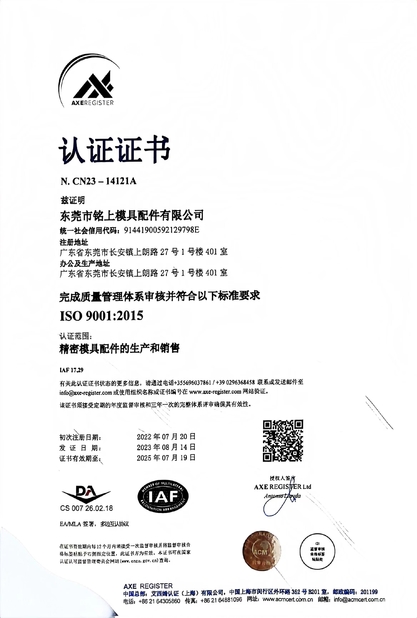
C'est aussi pour cette raison que certains acheteurs préfèrent de plus en plus les fournisseurs qui se positionnent autour de la capacité de processus plutôt que de la seule disponibilité des machines.SENLAN présente ses capacités en matière de composants de moules de précision et d'outils personnalisés pour des applications à plusieurs cavités, avec des allégations publiées, y compris des tolérances d'usinage jusqu'à ± 0,005 mm, les tours CNC Hardinge, le fraisage Röders, les procédés Makino et Sodick EDM, l'inspection ZEISS CMM, la mesure de la rondeur et ISO 9001:Contrôle de la qualité soutenu par 2015 avec 100% d'inspection avant livraisonQu'un acheteur évalue SENLAN ou tout autre fournisseur, c'est le type de soutien mesurable qu'il vaut la peine de demander.
En fin de compte, le fournisseur le plus fort est rarement celui qui a la brochure la plus impressionnante.et peut prouver ce qui a été fait avec des dossiers que l'ingénierie et les achats peuvent tous deux faire confiance.
Pour les acheteurs qui comparent les fournisseurs pour les composants de moules de précision, c'est peut-être le changement de mentalité le plus utile: ne comparez pas seulement ce que le fournisseur dit qu'il peut fabriquer.ce qu'ils peuvent vérifier, et ce qu'ils sont prêts à vous montrer avant le début du travail.


 Votre message doit contenir entre 20 et 3 000 caractères!
 French